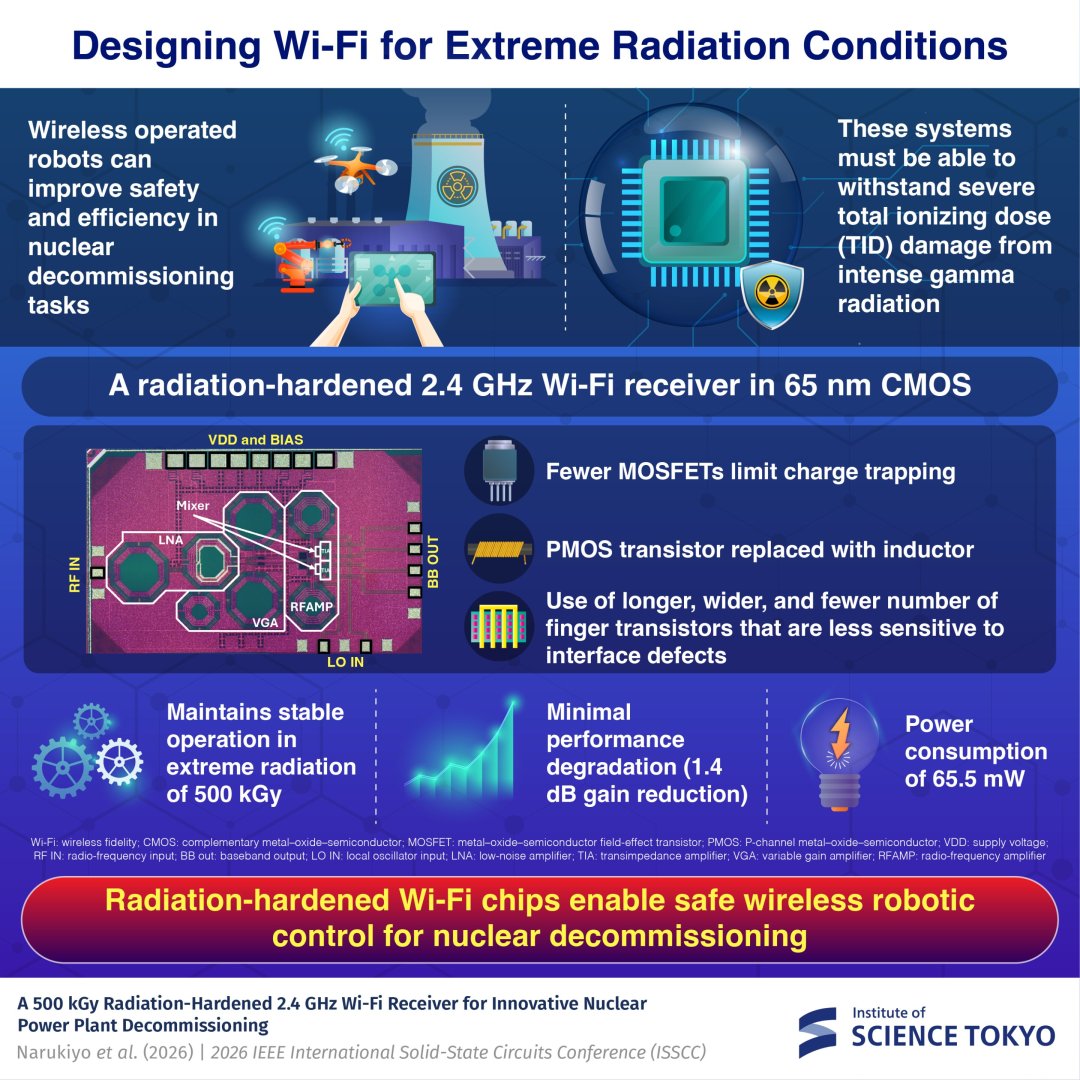
Researchers at the Institute of Science, Tokyo, have developed a new 2.4 GHz Wi-Fi receiver chip capable of withstanding ultra-high radiation doses of up to 500 kilograys (kGy).
The goal of this new chip is to solve the cable problem at sites like Fukushima Daiichi, where restrictive wiring currently prevents multiple robots from working efficiently in hazardous areas.
“Such tolerance addresses the requirements of nuclear power plant decommissioning, which involves exposure to intense gamma radiation emitted from fuel debris,” said Atsushi Shirane, Associate Professor.
Operators currently rely on robots connected by heavy LAN cables.
However, the tethers are a logistical issue because they often snag on jagged fuel debris, snap in confined spaces, and limit the number of robots that can work together.
Interestingly, this new Wi-Fi chip could finally enable the wireless control needed to make these dangerous cleanups faster and safer.
“Introducing such a wireless system eliminates the need for complex cabling and enables efficient and seamless operation of a large number of robots,” said Shirane.
So, how do you make silicon survive a nuclear storm? You simplify it.
The team realized that radiation kills chips by trapping electrical charges in transistors’ insulating layers. It causes leakage, where electricity flows where it shouldn’t, drowning out signals in a sea of static.
To enhance radiation resistance, researchers re-engineered the Wi-Fi receiver chip by reducing its transistor count, thereby minimizing the surface area vulnerable to electrical leakage and charge buildup.
Radiation-hardened design could help nuclear decommissioning robots
Key modifications included replacing radiation-sensitive active transistors in the variable-gain and radio-frequency amplifiers with inductors. These passive components that remain stable under intense gamma bombardment.
This streamlined architecture maintains high-performance signal processing across low-noise amplification and baseband conversion. It ensures the circuitry survives environments that would typically destroy standard electronics.
Moreover, the “edge-related” leakage paths typically caused by radiation were minimized by increasing the length and width of these components while reducing the number of parallel segments (or “fingers”).
This structural scaling suppressed unwanted charge trapping and leakage currents, ensuring the chip remains electronically stable even under intense, high-dose gamma exposure.
In performance tests, the chip demonstrated resilience after a massive 500 kGy radiation dose and maintained a high-quality signal with only a marginal 1.4 dB loss in gain.
Its noise levels and power consumption remained stable.
Ultimately, the chip’s communication capabilities stayed on par with standard commercial Wi-Fi receivers, validating its readiness for real-world nuclear and space applications.
Of the 423 nuclear power reactors currently in service, roughly half are projected to begin decommissioning by 2050, according to data from the IAEA.
“By realizing Wi-Fi chips that operate stably even under ultra-high-dose radiation environments, wireless remote operation using robots and drones will be promoted, enabling reductions in worker radiation exposure risk and advances in work sophistication,” said Shirane in the press release.
Interestingly, the chip’s ability to withstand radiation levels well above those of standard space-grade electronics makes it an ideal backbone for future deep-space exploration.
https://ljdevice.com.tw/wp-content/uploads/2025/09/2025-09-17_103735.jpg267389patrickhuang/wp-content/uploads/2017/03/logo.pngpatrickhuang2026-03-31 10:40:442026-03-31 10:40:44Nuclear cleanup robots could get radiation-resistant Wi-Fi chip for wireless ops